“I hate group work!” This is not uncommon to hear from a student. It comes up every time I teach Research Methods or Psychology of Women – the two courses that have several group assignments. I have empathy for students. Group work can be challenging.
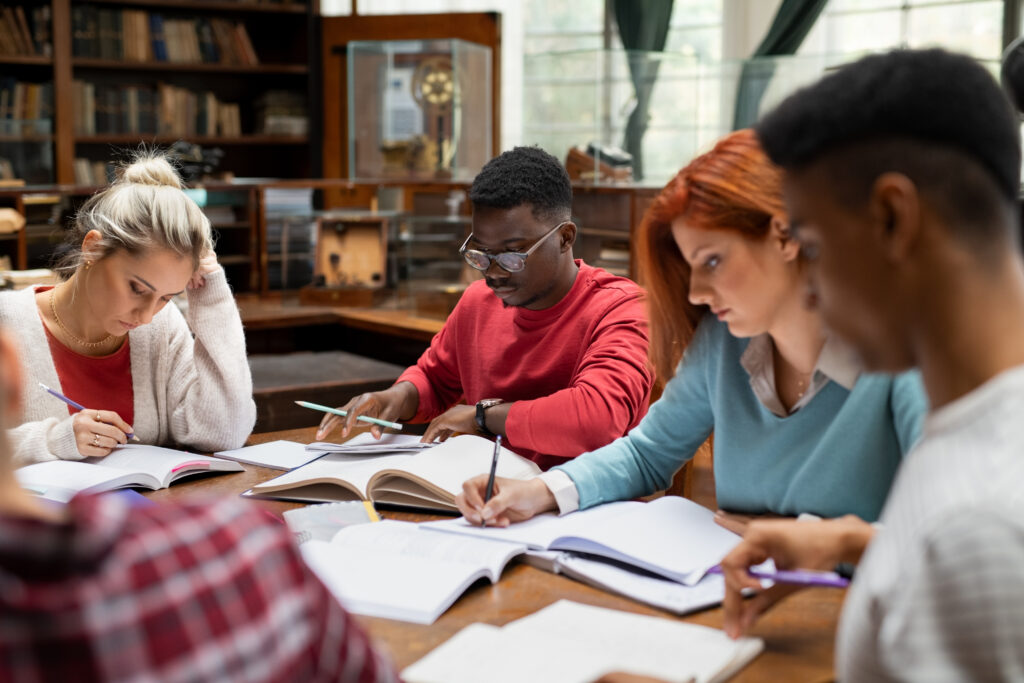
The truth is group work requires particular skills – skills that are not always valued in academia. So much of academic expectations, and thus academic evaluation, is individualized. In this way, higher education continually focuses on teaching competition over collaboration. As a feminist teacher, this is a problem for me.
We cannot expect students to organically know how to make group work effective. We have to teach skills that set them up for success. Fortunately, psychological literature has a great deal to offer our students in this area.
Together with my colleague Dr. Stefanie Sinno, we decided to tackle the group work challenge. We developed a list of skills we thought would help our students develop and maintain high performing groups. We clustered these skills into two categories:
Interpersonal skills – those skills needed to interact effectively with other people.
Intrapersonal skills – those skills that are needed to access one’s own emotions and the ability to discriminate among them, to regulate them, and to use them to guide behavior
Here is the list of skills we generated:
There are a number of ways I use this skill list to help students develop their skill sets. First, I use the list to introduce students to interpersonal/intrapersonal skills and to explain the why. For example:
- Interpersonal skills continue to rank among the highest attribute considered by employees and graduate training programs.
- When we seriously attend to interpersonal skills in our group work and in our class, we will (1) increase open-mindedness toward diverse perspectives, (2) improve leadership skills, (3) engage in effective communication styles, and (4) tolerate ambiguity.
Once I introduce the list and the why, I then ask students to rate their capacity on each skill on a 7-point scale, from 1=not very strong to 7=very strong. We then use these ratings as a basis to reflect on which skills are already strengths and which they need to grow in.

It’s important to scaffold learning so that students are first introduced to the skills and then given multiple low-stakes opportunities to practice and receive feedback about their progress. Throughout the semester, particularly after a group assignment, I have students go back to the skills and write reflective summaries about their own and their group members attention, or lack thereof, to interpersonal/intrapersonal skills. Here is a list of questions I have used in the past:
- Identify a moment where you believe you (or a group member) showed strength in an interpersonal/intrapersonal skill? What did you notice with the individual behavior, and how did it influence the group dynamic?
- Identify a moment where you wished you had attended more to interpersonal/intrapersonal skills. What was the barrier? If you could go back, what would you have done differently?
- How could you apply what you have learned in other courses you have taken across different areas of psychology to help you practice interpersonal/intrapersonal skills?
- Which psychological theories best help you to understand the development of your interpersonal/intrapersonal skills?
- Develop three research questions from three different areas in psychology that focus on interpersonal/intrapersonal skills.
Over the years, I’ve noticed that students will bring up impromptu the interpersonal/intrapersonal skills we discussed. To me, this is a sign that they are noticing when and where these skills could likely help them. We also have honest discussions about how the fast-paced demands of the semester and a desire to get a good grade interferes with their ability to slow down and take time to attend to interpersonal and intrapersonal skills. Students also notice that some people, particularly women, are more likely to attend to group dynamics. This has led to insightful conversations about how gender socialization affects our learning. Overall, more transparency and intentional focus on interpersonal and intrapersonal skills increases all students sense of responsibility toward learning these skills.